Degrees for GPTs: The Effects of Generative AI on Skill Demand and Supply
Abstract
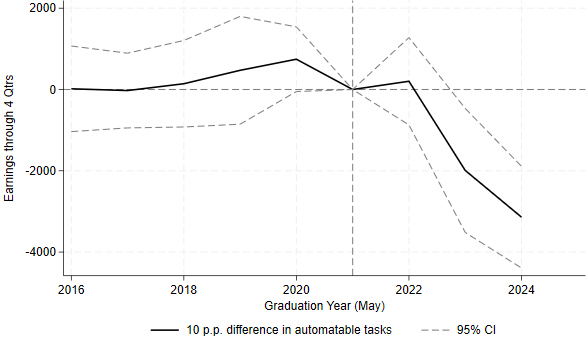
We examine how the rapid deployment of generative AI affects labor market outcomes and educational decisions of recent college graduates and current students. Using administrative records that link all students at Texas public four-year universities to state earnings data, along with detailed job postings data, we measure exposure to AI automation by mapping occupational task measures onto college majors. We find that graduates from majors with 10 percentage points higher exposure to AI automation experienced 10% lower first-year earnings following ChatGPT’s release in November 2022, driven by both reduced employment rates and lower conditional earnings. In response to soft labor demand, graduates from more-exposed majors were more likely to enroll in graduate school. However, they largely continued studying the same field, and earnings declines for recent master’s recipients in more-exposed fields suggest that graduate-level education does not unlock complementarities large enough to offset “automation penalties” in these fields. In contrast, graduates from exposed majors whose coursework tilted toward less-exposed fields experienced smaller earnings losses. Undergraduate enrollment data shows that younger students are pivoting away from AI-exposed fields as of Fall 2025, consistent with the delayed effects of prior sectoral shocks on major choice.
Media Coverage

Samuel Dodini
Senior Research Economist
My broad research interests include empirical explorations of the economics of labor markets, incorporating insights from behavioral economics, occupational licensing, monopsony power, education, public finance, and urban economics.